Showing posts with label George W Bush. Show all posts
Showing posts with label George W Bush. Show all posts
Saturday, July 24, 2010
The Problem With Going Someplace You Should Have Never Gone


Sunday, July 22, 2007
Why Do Utahns Support George W. Bush?
 It is interesting that, of all the states in the Union, Utahns still have the highest approval rating for President Bush than any other state. I think I know why.
For the included graphic, I am indebted to The Utah Amicus (by way of Richard Warnick).
No other state in the United States has as high of an approval rating for President Bush as Utah. As far as I know, it's been that way for quite some time.
Here are a couple of my theories why:
Theory 1
I have noticed of late that Utah Mormons generally seem to be much more forgiving of a president who misuses his executive power than of a president who is sexually immoral. At first I supposed this was due to their heads being filled on any given day with the mush of Rush Limbaugh and the rantings of Sean Hannity. I have lately decided, however, that the opposite is true; Utah Mormons worship Rush, Sean, and others because these so-called conservatives preach a “gospel” that is deceptively similar to the Gospel of Jesus Christ, to wit that we should eschew immorality while at the same time rendering unto Caesar that which belongs to him. The gospel they actually preach, though, is a politics of ad hominem attacks and division.
This, then, is my theory of why President George W. Bush as late as the end of 2007 still enjoyed an inordinate amount of popular support from the Utah crowd, while Utahns were among the first to call for the head of President Bill Clinton when his sexual improprieties became public. Most Latter-Day Saints are so busy living the gospel that they forget that politics are important as well.
Theory 2
The doctrines of the LDS church include the following statement about the Constitution and about liberty:
76 And again I say unto you, those who have been scattered by their enemies, it is my will that they should continue to importune for redress, and redemption, by the hands of those who are placed as rulers and are in authority over you—
77 According to the laws and constitution of the people, which I have suffered to be established, and should be maintained for the rights and protection of all flesh, according to just and holy principles;
78 That every man may act in doctrine and principle pertaining to futurity, according to the moral aagency which I have given unto him, that every man may be baccountable for his own sins in the day of judgment.
79 Therefore, it is not right that any man should be in bondage one to another.
80 And for this purpose have I established the Constitution of this land, by the hands of wise men whom I raised up unto this very purpose, and redeemed the land by the shedding of blood.
Doctrine and Covenants, section 101
I think a significant number of Utahns want to see liberty take root in Iraq. I think they are worried that if they don't express support for President Bush that it will be seen as lack of support for the struggles of the Iraqi people. I don't share this view (I think Bush has made a monumental mess of it), but I see how people could feel this way.
What do you think?
If you'd like to participate in the poll about this subject, look in the upper right-hand color of this page.
Saturday, June 16, 2007
"A Perpetual State of War"
 Of the issues on which I agree and disagree with former Vice President Al Gore in his new book The Assault on Reason, one to which I highly subscribe is the unhealthiness of being in "a perpetual state of war" with terrorism.
Sometime in late 2002 I remember hearing a radio news report wherein it was suggested that if we attacked Iraq, it would be likely that we would have to occupy it for up to 12 years. How strange, then, that it turns out that the Bush Administration did not have a post-invasion plan to undergo a successful occupation of the country.
Several members of Congress asked the Bush administration what its occupation plan was for Iraq.
...Secretary Rumsfeld said that he wasn't certain we would have any responsibility at all. "That's for the Iraqis to come together and decide," Rumsfeld said. At that very moment, we now know, he was attempting to shut down the program at the U.S. Army War College that was focused on post-invasion stabilization. (Gore, p. 190)
Others in the Bush administration said that the Iraq invasion and regime change would be a cakewalk. Surely, they knew better.
In The Assault on Reason, Al Gore makes this statement:
[If we subscribe to] the idea that we have entered a perpetual state of war, the implications of this theory stretch as far into the future as we can imagine. These claims must be rejected, and a healthy balance of power restored to our Republic. Otherwise, the fundamental nature of our democracy may well undergo a radical transformation. (p. 226)
If for no other reason than that Gore's statement is a challenge to all future presidential administrations, I find his statement very enlightening and profound. But it's more than that. It teaches (reminds?) us that we can't afford to elect establishmentarians to office. The perpetual state of increasing government--choreographed by background shadow puppeteers--in the United States makes me wonder how much differently Al Gore would have acted had he been president on 9/11. The fact that Al Gore was Vice President in an administration that gave a great deal of military and other concessions to the Chinese adds to my hypothesis, but for my current purposes, I will simply say that I agree completely with the above-quoted statement.
The fact that I opposed the Iraq invasion in the first place has been detailed in these pages. The negative ramifications of the invasion are becoming all the more apparent as the days and months go by. But regardless of whether we supported the invasion or not, the main focus of our criticism--now that we are there--is why we haven't done of better job of achieving our goals. (Sort of reminds me of a border fence that hasn't been built yet...)
Most negative ramifications of our Iraq invasion and occupation accrue due to the inelegant way the Bush administration 'planned' for the post-invasion. If plans had been made, my opinion is that the country would have been stabilized by now. But I am subscribing ever more readily now to a personal theory that 'no plan' was the plan.
How do we square the statements that we would be in Iraq for 12 years with administration statements that it will be a cakewalk, and that we don't need to plan for occupation? It can only be squared in the desire for the Bush administration to be in a perpetual state of war.
All of you who voted for president Bush were stupid. If you did it twice, you're really stupid (unless you've repented, as I know some of you have). Let's hope that the next administration turns back the tidal wave of executive branch power accretions. Incidentally, there are several candidates for president in both major parties whom we cannot hope to expect will turn back that tide. Perhaps not surprisingly, those candidates are indicated in national polls as being the most popular candidates for their political parties. Who makes these polls? Are they accurate? Are we really still that stupid?
How perpetually unfortunate.
Thursday, June 14, 2007
Bush as Hitler: An Ode to Springdale Bum
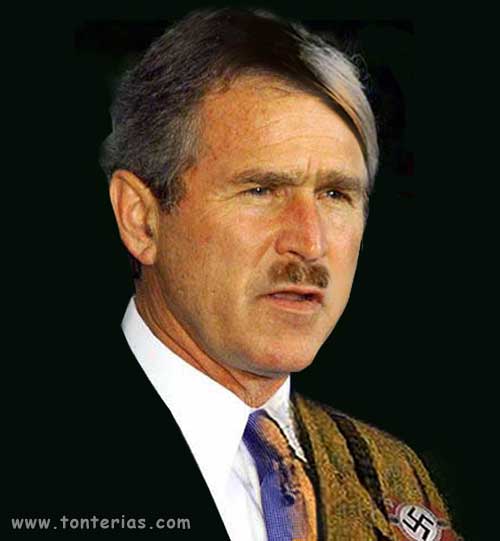
It may be that people disagree with George W. Bush as regards the Iraq war. I happen to. But for anyone to make a comparison between Bush and Hitler reveals in the comparer a daftness beyond description. When one goes further by saying that since Bush is Hitler we must hate the troops, it reveals the purely unthinking essence of the cancerous anti-Bush doctrine.
When the 222nd Field Artillery was deployed to Iraq in 2005 and 2006, we were augmented by members of the 145th Field Artillery. On June 12, we returned the favor. A lot of my good friends are headed for Iraq via Ft. Bliss, Texas.
So it don't sit too good when my friends and I are compared to Adolf Hitler's storm troopers. One may disagree with George Bush's policies as regards the Iraq war, but Bush is not Hitler. Nowhere close. What an inanity then, that "Springdale Bum" says that Bush is Hitler and we are Nazi storm troopers.
A German instructor of mine at Brigham Young University knows what it was like to live in the time of Hitler. He explained to us what it meant to be forced to belong to the Hitler Jugend and how any dissent was punished by disappearance and death. Bush has made several mistakes--but Bush is no Hitler. Springdale Bum wouldn't have lasted a day in 1940's Nazi Germany.
It was with some effort to control my composure when I said goodbye to my good friend and my son's baseball coach last Thursday at his last baseball game. He won't be at the game tonight, because he's on his way to Iraq. As my wife and I walked hand in hand from the ball park to the parking lot a week ago, we knew exactly what he and his wife were going through. And in a big way, we were glad that it was not us going through that torment again.
Here's the pertinent portion of Springdale Bum's comments to the article about the departure of the 145th:
..let me put your "I support the troops but not the war" stance to a test:
I'm a German citizen living in rural Bavaria in 1939 and while I think Hitler is a warmonger and that raping Poland and setting up a puppet government there to exterminate and root out anti-German "insurgents" is very bad, maybe evil, I still support our troops! While what they're doing in that country is probably very wrong and inviting disaster upon our land, by golly they are still OUR boys after all and I SUPPORT 'EM!
My position is that I don't support illegal and unnecessary wars. If I don't support the mission I CAN'T support the troops. The only true way to support the troops is by insisting that they all come back home to our shores immediately. Anything short of that is moral cowardice.
What is moral cowardice is to use a forum that is sure to be read far and wide by family members of the deployed as a knife in the back of all of them as they try to make sense of how they will endure the worries and struggles of the next 14 months without their husbands and daddies.
No matter what you think about their leader, you cannot blame the troops for answering the call of duty. What is moral cowardice is to use such a forum to equate me and my friends with Hitler's nazi thugs.
Yep, Springdale. You are a bum.
Thursday, February 01, 2007
Ignoring the Lessons of "Provide Comfort"

In 1991, President George Bush, Sr. encouraged the Shia in the south and the Kurds in the north to rise up against Saddam Hussein. But when the uprising occurred, the US military was required by the civilians in Washington to sit on the sidelines. Kurds flew from the wrath of Saddam into the mountains. Only after their dire straits became evident did the Bush administration send assistance, in the form of Operation Provide Comfort. We learned a lot about the Iraqi people and culture during that time, but very little of that knowledge was implemented in Operation Iraqi Freedom.
As operation Desert Storm came to a close, President George H. W. Bush encouraged the Iraqi people to rise up against their dictator, Saddam Hussein. US aircraft even dropped leaflets into Iraqi units in the field encouraging them to overthrow Saddam.
Then suddenly, the Bush Administration declared the war over. American military units sat sometimes within visual and hearing distance of the resulting slaughter perpetrated by Iraqi helicopter gunships on the rebellious Iraqi populace.
As Saddam wreaked revenge on the northern Kurds, they began to flee by the thousands into the northern mountains. Their situation was dire, with obviously poor sanitation and very little food. Finally, in late July of that year, President Bush relented and offered hope and help to the beleaguered Kurds.
General Jay Garner, later put in charge for a very short time of Iraqi reconstruction, commanded the operation. General Anthony Zinni was Chief of Staff for Provide Comfort. John Abizaid, then a Lieutenant Colonel, led the charge southward into Iraq, occasionally fighting and usually intimidating Iraqi military units into submission
We learned a great deal from Operation Provide Comfort. Ironically, not much of the lessons derived were used in what little preparation there was for Operation Iraqi Freedom in 2003. Three of the main players, who developed a great deal of practical knowledge about Iraq, its people, and its culture, were either persona non grata in the Bush administration or were required to take their orders:
- Jay Garner was given little time to prepare to lead the Iraq reconstruction effort, and was barely in Kuwait when the gig went down. When Bush's pie in the sky dreams went south, Garner's head was the first to roll.
- Anthony Zinni, who had been in the thick of Iraq during Provide Comfort, was dismayed at the cavalier attitude with which many in the Bush administration approached the Iraq invasion. Despite his warnings that America's leaders had grossly underestimated the task ahead of us, Bush jumped pell-mell into the fray.
- John Abizaid, recent commander of CentCom in Iraq, appeared to grumble under his breath often at the instructions of the Bush administration. After recently expressing his doubts about the Iraq "surge", he announced his retirement from the military.
Woops.
Tuesday, January 16, 2007
Incompetence

Even those who once cheered the war to replace Saddam Hussein and bring democracy to Iraq are having second thoughts. Call it a scapegoat, or call it what you want, but many of the former cheerleaders place the blame at the foot of the Bush Administration and its incompetence.
Updated 1-17-2007.
How do you lose a war?
1. Take away the President's decision-making power by never letting him hear the disagreements.
2. Refuse to admit mistakes.
3. Ignore the real war while you war amongst yourselves.
4. Fire the guy who gets out and does stuff and then take as gospel truth everything the guy says who is hunkered down inside a Green Zone of his own making.
5. Start before the plan is complete or the players are in place.
I guess I don't blame Colin Powell for stepping down as Secretary of State. He probably saw it all coming. Actually, it was probably nearly there.
Some of the neo-conservatives became disillusioned with the Bush Administration's ability to prosecute the war in Iraq about the same time Colin Powell did. Others are just recently expressing their frustration. Cliff (and others) on OneUtah, probably fairly accurately, asks (my interpretation) if the Bush Administration could really be that stupid. I don't think so, but they sure act like it.
I thought it the epitome of irony that Bush chose the number 21,500 as the number of troops we would need to complete the Iraq "surge" so that we could "clear and hold" Baghdad. It's
as though he were saying, 'We can easy do it with 20,000 more, but let's throw in another fifteen hundred just for good measure." This after Jay Garner and nearly all Bush's generals (except for Tommy Franks, whose military leadership experience was limited to the art of blitzkrieg) told him that we would need about 400,000 troops to accomplish the task at hand.
It all is coming to a head for me right now as I contemplate that my contribution to Iraq is likely going to be that I made a few friends and impressed several with my ability to speak some Arabic. No, I really don't think Bush is that stupid. Nor Cheney. Nor Rumsfeld. So what gives?
These are some of the thoughts I had as I read a recent article in Vanity Fair magazine.
Update 1/17/2007 - Like me, a lot of the Neo-Conservatives (I'm not one) felt that America would be helping Iraq achieve liberty. But it hasn't worked out that way, at least yet.
Richard Perle has this to say about what went wrong:
The decisions did not get made that should have been. They didn't get made in a timely fashion, and the differences were argued out endlessly. At the end of the day, you have to hold the president responsible.… I think he was led to believe that things were chugging along far more purposefully and coherently than in fact they were.If he were asked today, should we go into Iraq, his answer would be:
'No, let's consider other strategies for dealing with the thing that concerns us most, which is Saddam supplying weapons of mass destruction to terrorists.'Kenneth Adelman is more pointed about the incompetence of the Bush Administration:
I am extremely disappointed by the outcome in Iraq, because I just presumed that what I considered to be the most competent national-security team since Truman was indeed going to be competent. They turned out to be among the most incompetent teams in the postwar era. Not only did each of them, individually, have enormous flaws, but together they were deadly, dysfunctional.James Woolsey was very in favor of an Iraq invasion, but now is angered and perplexed that we are making the same errors that we made in Vietnam. One of the greatest problems is that we don't stay in an area that we have cleaned of insurgents. As soon as we leave, the insurgents return. This is not a problem that the military leaders have caused. It is a problem that could only have been solved by using the approximately 400,000 troops that many advised the Bush Administration to use in the first place. The paltry addition of 21,500 troops in an area the size of Baghdad will likely make little difference.
Sunday, December 17, 2006
Moral Support for Liberty - A Lesson for Iraq?

Presidents Carter and Reagan perhaps set the pattern for the success of democracy when lending America's moral support to the dissident movement of Poland. What would be the difference if America could roll back the clock to late 2002 and make a decision for moral support of Iraqi dissidents instead of invasion of Iraq itself? Would the United States and the world be in a better position today?
Some acquaintances of mine assume that, because I served with the United States military in Iraq, that I necessarily supported the decision of the Bush administration to invade Iraq. This is not the case. I actually contemplated retirement from the military rather than supporting the invasion. Speaking with family members, friends, and co-workers I explained to them that I did not think enough evidence existed to support an invasion.
In early 2003, I was notified that my National Guard field artillery unit was being activated and sent to Iraq. Beside being a traumatic moment for me and my family, I also remember a strange feeling of calmness. My thoughts were, "I volunteered to be in the military, and I'm still in, and I've been ordered to active duty, so it doesn't matter what my political feelings are at this point."
I ended up not, as first impressions were, participating in the initial invasion of Iraq; instead my battalion served in place of a regular army battalion that did participate in the invasion.
Six months later we were back home, and again I contemplated retirement. My wife and I thought and prayed about the decision, and felt strongly that I should continue my military service.
Two years after my first active duty stint concluded, my battalion was re-called to active duty, and this time found itself in Ramadi, Iraq. Over the course of my stay, my primary goal was to give the Iraqi people not only a good impression of the United States in general, but particularly a good impression of the American military. A few of those experiences are shared as earlier posts in this web log.
In retrospect, my wife and I are both glad that we decided I should stay in the military, and we are especially glad for my service in Iraq. However, I often have wondered......President Ronald Reagan was and is a hero of mine. I admire his ability to stand up with optimism against the adversary of despotism. That is why the following story and commentary is so informative to me, and it makes me wonder what would have happened if we could go back and have a do-over in Iraq--something the Carter administration began, and something in whose eventual success Ronald Reagan participated.
December 13, 1981 signaled, in retrospect, the downfall of the Communist Polish government, rather than the feared failure of Solidarity and the struggle for freedom.
Janusz Reiter, Poland's current ambassador to the United States, has this to say about that event:
The United States made the right decision. President Ronald Reagan accurately perceived that Poland offered the fulcrum needed to move things forward from the so-called Yalta pattern of a divided Europe. The United States gave the Solidarity opposition the support it needed most -- moral support. By doing so the Reagan administration followed in the footsteps of President Jimmy Carter's administration, which had listened to the advice of its national security adviser, Zbigniew Brzezinski, and strongly supported earlier dissident movements.
Ambassador Reiter also says of the United States' support for the dissident movement in Poland:
American leaders at the time showed a particular sense of psychological and political intuition.
First, they perceived in what direction Poland was moving and chose to support those who would later prove to be the catalysts of political and social change.
Second, there was never a doubt that Solidarity was a movement developed from Polish tradition and experience, and that the Poles knew what was best for their country. The United States respectfully accepted this.
Third, this was a great fight for hearts and minds. To win it, the United States opened its arms, in particular to the younger generations of Poles. Thousands of them -- scientists, artists, students -- then came to the United States. Some remained here, but many returned to Poland and used their American experiences to help deal with the growing pains of a newly democratic society.
Two differences immediately jump out at the way Poland and Iraq were treated by the United States.
- The Carter and Reagan administrations chose moral support, while the Bush Administration chose invasion, occupation, and nation building. The Bush administration's rationale was that the Hussein regime could easily attack us on our own soil, and therefore we must attack them on their turf; however, Carter and Reagan could have easily made a stronger case that the Soviets were much more able to attack us here than Saddam Hussein was.
- Solidarity, prior to the United States' moral support, had a much greater presence, organization, and purpose than did the dissident movement in Iraq. Lack of separation of church and state makes a sticky mess of political disagreement in the Middle East, so it may be a bit "pie in the sky" to expect Iraq's dissidents to be as unified as were the Poles of Solidarity. Nonetheless, a much greater groundswell toward liberty existed in the Poland of 1981 than did in the Iraq of 2003.
If George W. Bush had used the same tack for Iraq as Jimmy Carter and Ronald Reagan did for Poland, would Iraq be in a better situation today? In light of recent historical events in Iraq, if America steps back militarily from Iraq, will it be possible to provide moral support for the Iraqi "dissident movement", or is it too late?
A shorter version of this post originally appeared on OneUtah.org.
Subscribe to:
Posts (Atom)