
Monday, November 15, 2010
Why Are We Meddling in Iraq Elections?


Saturday, July 24, 2010
The Problem With Going Someplace You Should Have Never Gone
Monday, January 18, 2010
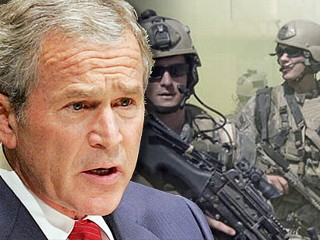
The Surge Worked? Then Why Are Candidates Being Banned From Elections?

Friday, September 11, 2009
Yes, Iraqis Remember 9/11
 Iraqis mourned with Americans on September 11, 2001. It wasn't long, however, before their tyrannical ruler was targeted as a possessor of weapons of mass destruction along with the intent to use them on America. When it was later proven beyond doubt that Saddam Hussein never had either such payload or such intent, it was too late for the Iraqi people. During our mid-stream mission change of bringing them "democracy", we have brought far more death, dismemberment, and destruction than liberty. Yes, Iraqis remember 9/11. It is still tearing their country apart.
When I got to Kuwait in June of 2005, I was surprised that all of the Iraqi and Kuwaiti workers on my transition base couldn't understand very much of my limited Arabic speaking ability. It turns out they were Indians, Pakistanis, Philippinos, etc.
When I got to my combat base in Iraq, the only three Iraqis workers I ever met there were translators who went with the brigade and battalion commanders, or with combat patrols as necessary. The rest of the workers were Indians, Pakistanis, Phillipinos, etc.
It was not until 2 weeks ago, after having been home from Iraq for more than three years, that I discovered that this wasn't just the norm on military bases in Iraq. Not only did we occupy their country on false pretenses, disband their military, and fire all of their government employees, we also (except in rare circumstances) didn't provide reconstruction jobs to any of the Iraqi people whose country we were occupying.
No wonder they hate us.
In her book, "The Shock Doctrine", Naomi Klein details what additional shock and awe U.S. uber-fuhrer Paul Bremer dispensed once the aerial bombardment was complete.
Before the invasion, Iraq's economy had been anchored by its national oil company and by two hundred state owned companies. The month after he arrived in his new job, Bremer announced that the two hundred firms would be privatized immediately. Bremer enacted a radical set of laws [one of which] allowed foreign companies to own 100 percent of Iraqi assets...Iraqi advisers warned in advance that these actions would be seen as acts of war. You probably already know at least that much of the history that happened next.
The Shock Doctrine, p. 436
But it gets worse.
Of the billions of dollars sent by the Bush Administration designated as reconstruction money--at least not the significant portion that was stolen outright by American contractors--almost none of it went toward contracts with Iraqi construction companies or to pay Iraqi workers, due to the fact that very few were allowed to participate. Klein says:
Even Iraqis' low-wage labor wasn't required for the assembly process because the major U.S. contractors...preferred to import foreign workers whom they felt confident they could control. Once again Iraqis were cast in the role of awed spectators...Despite the ignominy of American occupation, sectarian violence and violence against the military was almost unknown for at least the first year that we were there. Did you ever wonder where all of the insurgents came from? Well, now you know. Klein says:
Iraq once had one of the most sophisticated industrial economies in the region; now its largest firms couldn't even get a subsubsubcontract in their own country's reconstruction.
...cement factories were perfectly positioned both to supply the reconstruction effort with building materials and to put tens of thousands of Iraqis to work. The factories received nothing--no contracts, no generators, no help. American companies preferred to import their cement, like their workforce, from abroad, at up to ten times the price.
The Shock Doctrine, pp. 439, 441-442
In fact, all the forces tearing Iraq apart today--rampant corruption, ferocious sectarianism, the surge in religious fundamentalism, and the tyranny of death squads--escalated in lockstep with the implementation of Bush's anti-Marshall plan. After the toppling of Saddam Hussein, Iraq badly needed and deserved to be repaired and reunited, a process that could only have been led by Iraqis. Instead, at that moment, the country was transformed into a cutthroat capitalist laboratory--a system that pitted individuals and communities against each other... It was a very capitalist disaster, a nightmare of unfettered greed unleashed in the wake of war.Why can't we just leave these people alone? Are they better off now than they were under Saddam? A friend of mine asked me today if we were going to leave Iraq in a bigger mess than we found it. Yes, it seems like we will.
The Shock Doctrine, 443-444
How much longer are Americans going to believe the Bush Administration lie that our overarching goal was to bring democracy to the Iraqi people?
The Iraqis wish that 9/11 had never happened--but for very different reasons than most Americans do.
Wednesday, December 05, 2007
"Good News is No News", but Fallujah Holds Bicycle Race Anyway
 It's a pretty good sign that things are going much better in Fallujah if they were able to hold a bike race there recently.
 No news is good news, they say. Well, actually in America, when it has to do with Iraq, good news is no news. As the surge has helped to dramatically improve the lot of Iraqis all across the country, the American media has grown not-so-strangely-for-them more silent about the topic of Iraq.
Meanwhile, Fallujah feels comfortable enough--now that al Qaeda is on its heels--to hold a bike race.
December 3, 2007 -- About 150 students wearing colorful T-shirts competed in a bicycle race last week in Fallujah, an unimaginable event a year ago in what was once an al Qaeda hotbed and one of Iraq's most dangerous cities.
The city's police chief fired the starting shot to set the students from 15 intermediate and secondary schools off on the 5-kilometer race across the town, 30 miles west of Baghdad.
Scores of families lined the streets to watch the race and milled around the riders to congratulate them after the race.
"This proves that the security situation in Fallujah is very good," said Col. Faisel Ismael, head of the city's police.
"This is the beginning of good things in Fallujah."
Haitham Abdul-Razek raised his arms in the air as he crossed the finish line to win a $1,135 cash prize and a trophy.
"Bring the trophy! Bring it," some students chanted after the race, echoing a popular song among Iraqis after their national soccer team won the Asian Cup this year.
"Even though I did not win, I am happy that Fallujah's name was held up high today," said 17-year- old Marwan Khoedeiri, adding that he was not scared to compete, because of the security provided by police and army.
God bless the people of Fallujah and their fellow Iraqis. May they continue to enjoy ever increasing peace and prosperity.
Saturday, December 01, 2007
Murtha (Graciously?) Admits that the Surge is Working
 It was John Murtha's comments over the last couple of years that have caused a great deal of problems for the US military in Iraq. Now that he admits that the surge is working, should he demand our respect? No, but for once he is right.
John Murtha recently went to Baghdad. He had a change of opinion. He now believes the surge is working. I think we would have been better off long ago if he had kept his mouth shut, but now that he is talking, it's good that he's admitting the truth. But he's still suggesting that the wars in Iraq and Afghanistan only deserve $50 billion in 2008.
Investor's Business Daily calls it Murtha's "Road to Baghdad" conversion. I wouldn't go that far.
Beyond the embarrassing questions now sure to be asked of Pelosi about Murtha's unexpected flip-flop, and Democrats' crass unreasonableness toward a people who risk their lives to exercise the voting rights we take for granted, there's something bigger for Pelosi, Reid and the Democrats running for president to think about:Yes, the surge is working. Deaths are way down. Attacks are way down. Success is starting to bear fruit. But I don't think Murtha's admission that the surge is working is a gracious statement. I'm still waiting to see what else is up his sleeve.
Murtha, like so many other high-ranking Democrats in the House and Senate, and those seeking the White House, was "absolutely convinced" that surrender was the only answer in Iraq.
Tuesday, October 30, 2007
Help! Iraq is Improving. We Need More Sabotage!
 Despite what one may think about George W. Bush getting into the Iraq war mess, one must concede that his objectives are noble. The American military has only ever been in Iraq until such time as the Iraqis are ready for us to leave. We might have already been home had it not been for several half-witted stunts by the Democrats in congress.
The US Military today turned security over to the Iraqis in Karbala, only 40 miles south of my old stomping grounds, making that the eighth of eighteen provinces that now provide indigenous security. That's cool. We're making progress.
Although it's too early to be sure if it's a trend, the number of American military deaths is the lowest in two years. That's cool. We're making progress.
Despite the death of Abu Risha last month, Ramadi is trending toward peace. A recent parade was held in honor of Abu Risha. Troop and civilian deaths are way down. That's cool. We're making progress.
Which has me confused. Why aren't the Democrats in full overdrive--as they usually are at junctures such as this--trying to sabotage the effort? Careful...maybe they are...
My observation, albeit unscientific, while I was in Iraq was this: something goes good, like an election, and then the American media finds something negative to say about George W. Bush, and then, boom! Roadside bomb, car bomb, and rocket attacks suddenly increase. (Terrorists have satellite television.) That used to just piss me off.
Then John Murtha came along and made all sorts of brazen and baseless allegations, and the whole country went to crap. We're just recovering. That really sucked, and it still does.
I guess a few days ago, the Democrats did attempt a bit of sabotage, but it didn't seem to work. A recently tabled resolution before congress to censure Turkey for genocide that occurred nearly a century ago makes no sense unless one realizes its geopolitical ramifications.
Having failed miserably to force a US retreat in Iraq, House Democrats and their skittish Republican counterparts have now resorted to asymmetrical political warfare against President Bush, his administration and US military personnel in Iraq and Afghanistan.I'm all for being finished in Iraq. We should have never been there. But we can't just sabotage every good effort to achieve liberty among the Iraqi people.
About 70% of all supplies supporting current US combat operations flow through Turkey. Its strategic location has made the air base at Incirlik a vital lifeline to the US military. It doesn't take a legal scholar to articulate the implications to Iraq or Afghanistan if Turkey denied access to Incirlik.
I don't think we should rest on our laurels just yet, though. The enemy may still be combining in an attempt to scuttle the liberty process there. Al Qaeda, you think? Heck no! The Democrats in Congress!
Tuesday, October 16, 2007
US Casualties Down in Iraq
 It's a little early to tell, but it's interesting that US casualties are on pace for the lowest in any month in quite a while.
Cybercast News service is reporting:
Through the afternoon of October 15, the Defense Department reported that 15 U.S. military personal had been killed in Iraq since October 1. Thirteen of these were combat-related, while the other two were not. The most recent Defense-Department-reported death occurred on Oct. 12.It sounds like the counter-insurgency tactics employed by General Petraeus are working, and that perhaps the MoveOn.org crowd was a bit premature in saying that he was betraying the US. Hmmm.....
Last year -- during the same period -- 44 U.S. military personnel were killed in Iraq, all but two in combat-related incidents. That's more than three times the number of combat-related casualties now being reported for the first half of this October.
CNSNews adds that
September 2007 marked a 14-month low in reported casualties: 68 U.S. military personnel were killed in Iraq, a drop in deaths the military credited to the 30,000 "surge" in troops that began in June. Among the 68 U.S. casualties in Iraq in September, 41 were from combat-related incidents.It seems as well, from what I've been hearing on the radio, that car bombings are down, and the number of casualties from such bombings are down as well.
Sounds almost like a trend...or two.
Tuesday, October 02, 2007
Passing the Cost of War On To Future Generations

Democrats in the house are now 'concerned' that the $150 billion cost of the Iraq War will be passed on to future generations. Well, that's one way to look at it...
The Associated Press wrote today that:
Three senior House Democrats proposed an income tax surcharge Tuesday to finance the approximately $150 billion annual cost of operations in Iraq, saying it is unfair to pass the cost of the war on to future generations.
The plan, unveiled by Reps. David Obey, D-Wis., John Murtha, D-Pa., and Jim McGovern, D-Mass., would require low- and middle-income taxpayers to add 2 percent to their tax bill. Wealthier people would add a 12 to 15 percent surcharge, Obey said.
Since when did "pass[ing] the cost of [anything] on to future generations" stop anybody in Congress, with the exception of a handful of exemplary leaders, such as Ron Paul? We're certainly passing the cost of Social Security, Medicare, and Medicaid on to future generations.
But that's not all. The tax surcharge these congress people are proposing is another experiment in the socialist wealth collection shell game. If you don't make much money, you only pay 2%, but that's okay that we're suckering you poor people, because guess what? The rich SOBs have to pay EVEN MORE!!!
Despite how one may feel about the way we got into Iraq, one of the Constitutional requirements of the federal government is to provide for a defense of the country. Until these loons in the Senate and the House can figure out a way to get us out of this mess, I think there are better ways to pay for the war than a snide tax increase.
How about cutting spending in the myriad areas that they have no constitutional authority over?
Wednesday, September 19, 2007
Syria Missile Explodes, Followed By Media Blackout
 I didn't do a ton of looking around, but it seems that not too many news outlets are interested in reporting the fact that it is just coming to light that a Syrian missile which exploded at a Syrian military base in May killed dozens of Iranian engineers.
It was reported in May that a missile exploded in a Syrian military site. Today, new facts are surfacing. The major media outlets do not seem to be interested, although they are very interested in analyzing a recent Israeli air strike on a military facility in northern Syria.
The new facts are that dozens of Iranian engineers were killed in the May missile explosion. The blast occurred while engineers were trying to outfit a Scud C missile with mustard gas. AFP reports
The July 26 explosion in Aleppo, northern Syria, was reported at the time. The official Sana news agency said 15 Syrian military personnel were killed and 50 people were injured, most of them slightly from flying glass.
The agency said only that "very explosive products" blew up after fire broke out at the facility and that the blaze was not an act of sabotage.
But in the September 26 edition of Jane's Defence Weekly, Syrian defence sources were quoted as saying the explosion happened during tests to weaponise a Scud C missile with mustard gas, which is banned under international law.
Fuel caught fire in a missile production laboratory and "dispersed chemical agents (including VX and Sarin nerve agents and mustard blister agent) across the storage facility and outside.
"Other Iranian engineers were seriously injured with chemical burns to exposed body parts not protected by safety overalls," the publication quoted the sources as saying.
Among the dead were "dozens" of Iranian missile weaponisation engineers, it added.
Friday, September 14, 2007
What I Learned About Iraq From Losing a Consultant

Recently, our computer programming project ran out of budget for external consultants. At what I particularly felt was a very inopportune time to let them go, we let them go. Interestingly, however, I learned a great deal about myself in the process. That is, when I don't have someone to fall back on, I have the ability to rise the occasion.
Since the consultants left, I have become a markedly better programmer. I have come to several solutions that at first appeared to be very small needles in very giant haystacks. The key realization I came to just yesterday was that had my subject matter experts (the consultants) not left, I would have been content to float along in my relative mediocrity.
It is a very imperfect comparison, I know, but I'd like to illustrate my situation as a microcosm of Iraq. America is the subject-matter expert for Iraq--their crutch. As the situation drags on, Iraqis will be more likely to "float along in [their] relative mediocrity". At some point, coming soon to a theater near you, Iraq needs to get rid of its consultants. I guess I'm glad that President Bush announced last night that he intends to draw the American forces down over the next few months to pre-surge levels, although I don't think he did a good job of explaining why.
Lanny Davis, former member of the Clinton Administration, appeared on Greg Allen's the Right Balance this morning. He made a good point. The Democrats have a good point, which I have just spent the last couple of paragraphs essentially agreeing with. They are not, however, articulating it very well.
Lanny Davis said that we need to have a phased draw down in fairly short order to let the Iraqis know that it's time to realize that their consultants are leaving. Every Democratic candidate for president believes this. So far I think only Barack Obama has done a good job of articulating it. Only one Republican candidate, Ron Paul, believes that the consultants should take their leave. He has articulated very well, too.
I think the surge is working. I think Iraqis are realizing that the Americans (at least the soldiers, if not the politicians) care for them. I think the Americans know that it is a tenuous relationship, i.e. that the Sunnis in Anbar will turn against the Americans if we overstay our current purpose.
Our current purpose, I think, will soon be at an end. Let's give the Iraqis notice that they will soon be on their own, and let's hope and trust that they will be able to shine without their consultants.
Thursday, September 13, 2007
With Abu Risha's Death, The Cheerleaders Are Jubilant
 Hurray, the anti-war bigots are shouting. Abu Risha is dead! I find it hard to stomach that so many Americans do cartwheels when something goes wrong in Iraq. But they're doing it again. Their hope for failure in Iraq is palpable and pathetic.
Today in a car bomb explosion prepared by al Qaeda, Abdul Sattar abu Risha and some of his body guards were killed.
The assassination Thursday of the leader of the Sunni Arab revolt against al-Qaida militants dealt a setback to one of the few success stories in U.S. efforts to stabilize Iraq, but tribesmen in Anbar province vowed not to be deterred in fighting the terror movement.
American and Iraqi officials hoped the death of Abdul-Sattar Abu Risha would not stall the campaign to drive al-Qaida in Iraq from the vast province spreading west of Baghdad and reconcile Sunnis with the Shiite-led national government.
And there was glee in the streets of anti-war America! Rob Kall of Op-Ed News gloats
"What's the bottom line to this killing,"- I asked.
Rowley answered, "It puts the lie to the statement that there's security in the region."-
"Bottom line," finishing my interview with Rowley, I said, "This is a charade, a chimera, this success which Petraeus portrays is actually something that will fall apart when the money stops coming in and could actually explode into far worse conflict, when the troops leave."
That statement is far from necessarily true, and can only be interpreted as a not-so-subtle hint of a hope of failure in Iraq.
The previous excerpt was from an interview Mr. Kall had with a so-called reporter in the region, a Rick Rowley, who clearly has an opinion and an axe to grind. Mr. Rowley's main sources, besides himself, for his claims are members of the al Dulaimi clan, who are know to have had serious disagreements with abu Risha.
As the Associated Press reported
"This is a criminal act and al-Qaida is behind it," said Sheik Jubeir Rashid, a senior member of Abu Risha's council. "We have to admit that it is a major blow to the council. But we are determined to strike back and continue our work. Such attack was expected, but this will not deter us."
Ali Hatem al-Sulaiman, deputy chief of the province's biggest Sunni tribe, said that if "only one small boy remains alive in Anbar, we will not hand the province over to al-Qaida."
Prime Minister Nouri al-Maliki, a Shiite who had been reluctant to support Abu Risha, expressed "great sorrow" over the killing, but said he was confident "that this criminal act will strengthen the determination of Anbar people to wipe out the terrorists."
Meanwhile, someone who is constantly mingling with the military and with the Iraqis in Anbar and elsewhere, Michael Yon, has a completely different perspective. Here are some excerpts from his recent dispatches.
Back in 2005, many Iraqi Soldiers and Police preferred to hide their identities.Today it seems that most Iraqi Soldiers and Police want their photos taken. Their confidence is growing and their attitude toward the terrorists is increasingly one of being more the hunter than the hunted.
Shops in Anbar [are] reopening. Cigarettes [are] for sale. Just recently, al Qaeda was executing people who smoked, but this shop was selling cigarettes on the street.
To many of the Iraqis I’ve spoken with, terrorists are fair game. Kill them. But if we kill justice while doing so, we will create terrorists out of farmers. Here the Marines are creating farmers, police officers, shepherds, and entrepreneurs out of insurgents. To do that, they have to be seen as men who respect and honor legitimate systems of government and justice.
The sheiks of Anbar turned against al Qaeda because the sheiks are businessmen, and al Qaeda is bad for business. But they didn’t suddenly trust Americans just because they no longer trusted al Qaeda. They are not suddenly blood allies. This is business, and that’s fine, because if there is one thing America is good at, it’s business.
This conflict is often cast as either a battle between good and evil, or as a clash of religious ideologies, perspectives that fill cemeteries with brave souls willing to die for something they believe most fervently.
Reframed thus from a position of strength, this stage of the Anbar-war is more a sort of business transaction, where alliances beneficial to all sides—except al Qaeda—are formed. From this perspective, there is now a moment of genuine ground-floor opportunity in Anbar, if the people here can see that by doing business with the Coalition, everyone benefits—except al Qaeda, an exclusion that most can live with.
Politics often sucks. But beyond the politics are the people, in this case, the Iraqi people. Far beyond the news headlines, many stories are being made. Stories of success. Stories of friendship. Stories of improving lives.
I think I trust Michael Yon more than I trust Mr. Rowley.
I wish the anti-war cheerleaders would change their cheer for a while. Little by little, it's working. People's lives are better. Life in Anbar is improving.
Thursday, August 30, 2007
I Wouldn't Trust Muqtada al Sadr With a Ten-Foot Pole
 Muqtada al Sadr has been a pain in America's butt from nearly the beginning of the occupation. He has taken many a trip to Tehran. So it wouldn't surprise me if his latest decision to call for a suspension of Mahdi Army operations for six months is a ploy.
 But what about the new guy--Ammar Hakim?
Muqtada al Sadr is walking proof that the Iranians are involved in the Iraqi insurgency.
Paul Bremer wished that he had been successful in getting rid of al Sadr early on in the Iraqi occupation. The half-hearted way about which the attempt to do so was prosecuted caused al Sadr to gain an even greater following than he had before. He is still very well thought of among a large segment of the Shia population in Iraq. So it's not likely that he's up to much good when he asks for his Army to cease operations for six months. That can only mean trouble, especially when General David Petraeus is set to report on Operation Iraqi Freedom successes before congress next month.
The BBC says:
To some extent it may be merely a tactic aimed at distancing himself from the recent violence in Karbala.
It is certainly a tactic he has used before to distance himself from some of the worst excesses of the Mehdi Army.
But it is a puzzling and potentially risky move by the young Shia leader.
Puzzling because the very call for a re-organisation of the Mehdi army would seem to be an admission that he has lost control of it.
It's not that simple. One way or the other, the Mahdi Army will continue to fight. Now is the time for coalition forces and the Iraqi people to be most on their guard. Something is brewing.
Muqtada is all about power. He's all about himself. I wouldn't trust Muqtada al Sadr with a ten-foot Pole.
I'm not sure what to think of Ammar Hakim, another 30-something who is stepping into the limelight as leader of the Shia Supreme Islamic Iraqi Council, which got into fighting in Kerbala in the past few days with members of al Sadr's army. Hakim has been several times to Iran as well. But at least he talks a good talk:
"We are not agents of Iran," he said. He pointed out that it was his father who had encouraged Iran to open a dialogue with the United States about Iraq, and he said it was in Iraq's interests to maintain good relations with both countries.
He cautioned against a sudden drawdown of U.S. forces, saying it would be dangerous for Iraq. He said he supported a U.S.-sponsored bill to regulate the distribution of Iraq's massive oil wealth. And he expressed willingness to compromise with Sunni Arab politicians.
Based on his early hatred of Saddam (he was taught at age 4 to participate in the anti-Saddam forces) Hakim may see the light of what America is trying to help Iraq accomplish. Time will tell whether he contributes to peace and stability in Iraq. But we already know quite a lot about Muqtada al Sadr. So far, he hasn't. Do you suspect he's turning over a new leaf? Don't count on it.
Tuesday, August 28, 2007
Very Amanpoor Reporting on Jihad

The left screams that the media has a rightist slant. Well, I've got at least one instance where that is not true. Christiane Amanpour did essentially everything she could to misrepresent the truth in a recent CNN program entitled God's Warriors
Prior to its airing on CNN, it was said of God's Warriors by the Associated Press that
Understanding is what Amanpour is trying to promote in "God's Warriors," which takes up six prime-time hours on CNN this week.
Please...don't insult our intelligence. When someone tries to promote understanding, they try to get their facts straight. Not only did she create a great deal of misunderstanding, she caused a great deal of unneeded animosity.
One can dispute why radical Islam is so violent, but it is beyond dispute that
It is "deeply false," to equate "Jewish (and Christian) religious fervency with that of Muslims heard endorsing 'martyrdom,' or suicide-killing. There is, of course, no counterpart among Jews and Christians to the violent jihadist Muslim campaigns underway across the globe...
I wrote about this several months ago in The First Jewish Suicide Bomber. My point: there is yet to be one.
Jews and Christians, as compared to radical Muslims, almost never resort to violence to get their points across.
Much of the segment God's Christian Warriors deals with a man named Ron Luce, depicting him as representative of Christians. Ron who? I've been a Christian (Mormon) for 44 years, and I've never heard of him. I didn't check, but perhaps one of Ms. Amanpour's "fact checkers" was Rosie O'Donnell.
But much of the rest of "God's Christian Warriors" depicts the ministry of Ron Luce. His priority is battling what he views as an amoral popular culture. There's footage of one of Luce's "Battle Cry" youth rallies, which took place in San Francisco in March; in an understated and effective way, the documentary depicts how the two-day event used all the trappings of an extravagant rock concert to condemn most aspects of modern culture (of which rock concerts are part).
Amanpour made more than a few factually incorrect statements on the program, which can't do well to soften the angered feelings between Christians and Muslims and well as Jews and Muslims. For example, HonestReporting notes the following inaccuracy:
Amanpour does not hesitate to inject her own views, demonstrating occasional lack of knowledge. For example when an Israeli settler said God says Jews must live in Hebron, Amanpour interjected that the West Bank was designated by the UN to be the largest part of an Arab state. Not only is this statement factually incorrect, it is out of context. Amanpour is evidently unaware that all Arab states rejected UN partition resolution 181, to which she evidently referred and that the West Bank was included in the area designated for encouragement of Jewish settlement by the Balfour Declaration and even endorsed in article 6 of the British mandate.
The program also tended to be historically very out of context.
One of the most misleading aspects of the program, was the use of the very few isolated incidents of Jewish terror attempts over the past 15 years, to create the false impression that a Jewish terror movement exists on a par with the violent worldwide jihadist phenomenon of indiscriminate death and destruction.
I'm not sure whether Christiane Amanpour had a motive for the plethora of inaccuracies in her series, God's Warriors, nor if she did, what that motive would be. She's married to a former Clinton Administration official, but I'm not sure how that would play into the factual bias, except that Bill Clinton made a somewhat applicable statement at the time of the Oklahoma City bombing, claiming that right-wing Christian fundamentalism and talk-show hosts had created the environment in which such a bombing could have occurred.
But at least, if Christiane Amanpour does not have a motive for her inaccuracies, her professionalism calls on her to recognize those untruths and apologize for them.
Especially in issues so volatile, factuality is critical. False statements purported as fact can have the same effect as swords, rockets, and bombs.
Thursday, August 23, 2007
The Best Reason to Get Rid of al Qaeda? Al Qaeda
 Even the Democrats are conceding that things are looking better in Iraq. The reason that they are better is that as time goes on, more Iraqis see that the US Military has much more integrity than al Qaeda.
Even though accidental deaths are higher for the month of August, the death rate is still about that of July--part of a lower trend of US military deaths. Even considering the large scale killing in the otherwise peaceful northern Iraq this month, civilian deaths are maintaining their downward trend. Democrats in the US Congress are conceding that we're making progress. Why is this?
First of all because the surge is working. The general populace is being treated with more respect by the US military. The insurgents are getting their butts kicked. But there's another reason.
As the smoke begins to clear from the surge, Iraqis are beginning to see a distinctive difference between the US Military and al Qaeda. You can trust one but not the other. Michael Yon, who currently resides in Al Anbar, puts it this way:
Ironically, in Anbar Al Qaeda has become our best ally for killing al Qaeda. They’ve managed to do this directly, just by being al Qaeda. Despite the promised carrots, what Al Qaeda consistently delivered here was mostly stick, and with a special kind of hypocritical contempt that no sensible person would believe possible. (Not unlike the notion of baking the children of resistant parents or ordering shepards to diaper the corrupting genitals of goats.)With the success of General Petraeus's plan, even some of the bigger fish are trying to call a truce. Captain's Quarters noticed this interesting development.Al Qaeda has a management style—doing drugs, laying up sloppy drunk, raping women and boys, and cutting off heads, all while imposing strict morality laws on the locals—that makes it clear that they have one set of principles for themselves, and another for every one else.
In that kind of scheme, it didn’t take long before people in Anbar realized that any benefits from Al Qaeda having control would not be distributed equally. Once that realization spread, the tribal sheiks—almost all Sunni—had to consider the alternatives.
Earlier today, the Italian news service AKI reported that the presumed leader of the largest insurgency in Iraq will start cooperating with the Iraqi government. Izzat Ibrahim al-Douri, one of the highest-ranking members of Saddam Hussein's government, reportedly pledged to work with Iraqi and American forces to fight al-Qaeda in Iraq.
Things have been improving, and they continue to do so. But it looks like our counterinsurgency tactics, which have been bearing fruit for quite some time now, are reaching critical mass. Hopefully, future improvements will be larger and/or more frequent.
al Qaeda is no good. They are not good Muslims. The Iraqis are starting to notice this en masse. Even a couple of Democrats have as well. What happens if things continue to improve? Democrats asking for Bush to serve a third term?
Tuesday, August 14, 2007
John Murtha Apologizes to Haditha Marines
 As it comes to light that John Murtha was premature in his criticism of the Marines and incorrect in his assessment about what happened in Haditha two years ago, will he apologize? I predict that you will never see the headline "John Murtha Apologizes to Haditha Marines".
Where is Congressman John Murtha now that several Marines who were charged with murder from a November 19, 2005 incident in Iraq have been exhonerated? Has he apologized for mischaracterizing what happened there and then? Nope. But he was wrong, and I suspected he was wrong way back then.
I was in Ramadi in September of 2005, when six Marines at an established observation post not far away in the town of Haditha were overrun by a band of al Qaeda insurgents and killed. The insurgents displayed and wore captured equipment from the soldiers and taunted the US military in the process with a lot of free television air time. About a week later, a gigantic bomb killed 14 more Marines in Haditha. The air-time for those killings was enormous and enormously gratifying for the newly emboldened Haditha terrorists. Some people could be forgiven for imagining that the Marines might use these events as a pretext to ignore their rules of engagement in Haditha as retribution. But you can't be forgiven for voicing these concerns on international television, as Congressman John Murtha did. Such actions are treasonous.
An improvised explosive device tore through a convoy and killed another Marine on November 19th. Under normal circumstances, the Marines would be expected to seek retribution, right? Apparently, Congressman John Murtha thought so, when at the time he said "our troops overreacted because of the pressure on them, and they killed innocent civilians in cold blood." How can John Murtha be forgiven for speaking out without possibly being able to know the facts surrounding the events and fanning the flames of American liberal hatred of the American military in Iraq, despite the suspicions of a senior Marine officer that he supposedly was privy to. The event quickly but incorrectly came to be referred to as The Iraq My Lai, despite even if the allegations of Haditha were true, the two incidents are hardly comparable.
Oops! So sorry.
It turns out John Murtha was wrong, and yesterday he apologized.
Just kidding.
Even though nearly every member of the Marine unit that supposedly went on a rampage that night has been exhonerated, John Murtha is still in hiding.
His premature revelation of a conversation he supposedly had with "The Commandant of the Marine Corps" is inexcusable. It did more than almost any other event to sour the American public on the Iraq war. It created in many who were violently opposed to the war unfair expectations that many heads should roll, regardless of what the truth is.
The American opinion of the Iraq war (and the greater or lesser likelihood that US troops would exit Iraq) has a marked effect on the Iraqi mood toward the American troops. But John Murtha was not interested in the proven innocence or guilt of those supposedly involved in the Haditha incident on November 19, 2005. It was supposed that at least 6 individuals would be found guilty of their participation in the events of that evening. All but two, however, have now been exonerated. The trials of the last two marines are still future, but the political pressure will now be enormous to find the last two to be tried guilty of murder, in large part because of what John Murtha said.
He was clearly wrong to reveal to the American public what he had heard. But he didn't care. He's in lockstep with those who have overinvested in American failure in Iraq. The exoneration of yet two more of the Haditha Marines is very frustrating to those who already have their minds made up that America should fail in bringing liberty to Iraq. So if you're planning on holding your breath until John Murtha apologizes, I give you fair warning--your bones will long have decayed in your grave before that happens.
Friday, August 10, 2007
Ramadi Enjoying New Sense of Hope and Optimism
 Things started to improve when I was in Ramadi in the first half of 2006. But it's really improved in the year since then.
I left the Ramadi area in June 2006. According to an ABC news story, there were 450 attacks in that month. A year later, in June 2007, there were only 25.
The image you see above is Ambassador Ryan Crocker in downtown Ramadi, without a flack vest. It is working between the US and the Iraqis, because they understand more all the time that we're there to help.
Click here to view the ABC News Story.
Sunday, August 05, 2007
PBS: "See No Islamism, Hear No Islamism, Speak No Islamism"
 Before watching Muslims vs Jihad, the companion to the supposed-to-be-on-PBS-but-now-isn’t documentary Islam vs Islamists, I thought PBS didn’t want to show Islam vs Islamists because the show did not do a good job of depicting that large segment of the Muslim population that does not support Islamism and terror. I was wrong. The thing which ultimately gives PBS pause about Islam vs. Islamists is that the moderates actually do such an excellent job of pointing out the debaucheries of the Muslim radicals.
Now I know why they won’t show it. Because the truth hurts those who don’t want to admit or let it be known that an enormous chasm exists between moderate Muslims and hate-filled Islamists. PBS claimed not to see the moderate Muslims as representative of mainstream Islam. It’s a subtle play on words, but moderate Muslims are Muslims just the same.
Radical members of any society will get more print and airtime that their moderate members. That's the sad fact of an American media who wants whatever is salacious as opposed to whatever is true. Real Clear Politics explains why a cursory glance at our world makes it seem like there are very few moderate Muslims:
Are there moderate Muslims? And if there are, why aren't they speaking out against the beheaders and the suicide bombers?
A lot of people ask those questions. Canadian filmmaker Martyn Burke set out to answer them. He made a documentary. "Islam vs. Islamist," which was financed in part by a $675,000 grant from the Corporation for Public Broadcasting.
Mr. Burke hired journalists who reported from Denmark, France, Canada and the United States. There are a great many moderate Muslims, they found, but they don't speak out because they are intimidated by threats of coercion, ostracism and physical violence from the Islamists in their communities.
It’s no wonder that very few moderate Muslims speak out. Have you ever been threatened with violence if you speak out about a certain issue? Many of these people have. It takes great guts to stand up and speak out in the violent face of Islamists, let alone when you find they have their sycophants, such as the “See No Islamism, Hear No Islamism, Speak No Islamism” PBS.
According to a Fox News broadcast, in which several segments from the film were shown and discussed, PBS said the film was alarmist and overreaching, and that the producers of the film had demonized the Islamists. The film did no such thing; it simply allowed those who themselves had been demonized to speak the truth. I can’t help but wonder if PBS is afraid of the screechings of such groups as the Council on American Islamic Relations, who don’t want Islam vs. Islamists to be shown. It is clear to anyone watching the video that moderate Muslims blame Saudi Arabia for financing the bulk world Jihad. The Saudis, therefore, who have a great influence on America and many friends in American high places, will by no means be flattered by this film, and they have a great interest in its not being shown.
Nahid Riazy is one who dares to stand up against the excesses of Islam, such as the mistreatment of women. Many such still-Muslim women, including her, fear for their lives. Some are afraid to have their faces on camera, but she is not. She and others have had obscenities shouted at them and eggs thrown at them as they walk down the street. Others have been killed. Leaders of the Islamists, such as Said Mansour, claim that these women are not really Muslims (a spurious charge often made even by non-Muslims against those who do not follow the Islamist variety of Islam), and that in their struggle for democracy and liberty, they are actually limiting themselves.
Many crisis centers are being created to help these women.
Mansour said that Muslims must be God’s slaves--which apparently gives him and others like him the authority to be God’s taskmasters. They are doing a fine job of it! “You don’t ask questions about the religion. You are either a total Muslim, or you are not [a Muslim],” he said in an interview during the film.
Frank Gaffney, who helped with the film, said that PBS wanted them to change the story, to illustrate a moral equivalence between the Islamists and those who opposed their violent form of Islam. The producers of Islam vs. Islamists made several changes over the course of six months, but they refused to subvert the truth about the controversy inside the Muslim religion. They brought in several consultants from Paris, Scandinavia, and Canada, who agreed that the show was accurate, and who came to the conclusion that PBS must have already decided that it would never be satisfied with the end result.
Abd al Malik of France was in earlier years being drawn in by the thuggery of fundamentalist Islam. Then 9/11 happened. He is now a popular rap star (and is still a Muslim) in France. One of his most popular pieces is called “September the 12th”. Here are some of the words:
I already knew a flow of whackos when the twin towers went down
I already knew a flow of crazies when the twin towers were blown out
I was profoundly shocked. And let me tell you
If I hadn’t had my faith, I would have felt guilty for being a Muslim.
After that the eyes of the world were on us
And we had to show the world that we were human to
That if some of us were crazies
Most of us would never mix our politics with our faith
Previously, when al Malik joined the Islamist gangs of France, looking for and threatening those Muslims who did not seem as Muslim as they were. When he was assigned to plant a bomb in a French police station, he decided that Islamism was wrong, and he left. When he decided to go into the music industry, his break with the Islamists—who felt any kind of music was bad—was complete. Since then he has discovered that the correct--the real--Islam is peace.
The rise of this poisonous version of Islam is being funded by Saudi Arabia. Ahmed Amiruddin, a Muslim sheihk living in Canada, who has been threatened for his view, thinks the attraction of fundamentalist Islam is the glory of a past that was lost. Faheem Bukhari of Canada agrees that the tenets of the radical version of Islam that are being perpetuated in North America are exclusively of a Saudi variety.
Are the movies Muslims vs. Jihad and Islam vs Islamists worth your time? Not only are they, you can’t afford not to watch them. The DVD of Islam vs Islamists is in the pre-production stages, and will hopefully be available later this month. For now, you can watch segments of Muslims vs Jihad by clicking here.
At the very least you can make your own decision about what is really happening in the Muslim world. Unfortunately, PBS doesn't want you to do that.
Friday, August 03, 2007
The Religion Terrorists and the Information Technology Terrorists

The Information Technology terrorists are getting as sophisticated as the religious ones--particularly those of the Islamist type. Hearing what the information security companies are finding makes me think I'm back in Iraq.
The information terrorists seem to be learning a great deal from the religious terrorists. Their tactics continue to improve and their attacks mount. But the one thing they haven't learned yet is to try and make a moral case for their terrorism. It's been working for the religious terrorists--many people take their moralistic claims hook, line, and sinker.
Information Week reported recently about the number of phishing attacks on banks around the world.
The number of hackers attacking banks worldwide jumped 81% from last year, according to figures released at the BlackHat security conference Thursday. Researchers from SecureWorks also reported that hackers going after the company's credit-union clients increased by 62% from last year.With time, terrorists improve their tactics. It doesn't matter if the religious ones are in Iraq or not, they'll find a way to become better at the atrocities they commit. They're getting very good in Europe, fairly good in Canada, and they're starting to appear in the US.
So why are there so many more hackers this year than last? Joe Stewart, a senior security researcher at SecureWorks, told InformationWeek that highly technical and savvy hackers are no longer the only ones in the game.
Hackers no longer need to be technical wizards to set up an operation to steal people's banking information and then rob their accounts or sell their identifying information to an even bigger cybercriminal. Hacking toolkits and malware are for sale in the online underground. All hackers need are basic technical skills and the knowledge of where to go to buy what they can't build themselves.
"You go to a Web site and pay a $100 to several hundred dollars, and you can buy a turnkey exploit package," said Stewart. "You can buy the malware too, and then you're in business You put these components up on a Web site and immediately start infecting people. All you really need to know how to do at this point is set up a Web site."
This new ease-of-use is evident in the numbers.
Below is the part of the IW article that sounded the most interesting. Change a few words of it, and it sounds like raiding terrorist hideouts in Iraq.
"The amount of stolen financial data we have found since the first of the year has been daunting," said Don Jackson, a security researcher with SecureWorks and the discoverer of the Gozi and Prg Trojans. "With the Gozi, Prg, and BBB Trojans alone, we found millions of dollars of data sitting in their stolen repositories. These data caches contained thousands of bank-account and credit-card numbers, Social Security numbers, online payment accounts, and user names and passwords, and we're finding new caches of stolen data every day -- evidence that more and more criminals are getting into the game."
"Criminals are getting into the game" ... you could say that about the religious terrorists as well. They're mostly just criminals.
Hopefully the information terrorists don't start studying Karl Marx and Vladimir Lenin and Josef Stalin to soon, or we might find them announcing to the world that they are simply getting their due from the greedy capitalist pigs of America as well.
Monday, July 30, 2007
The "Mini-Surge" is Showing Some Promise
 For those who disagree with the Iraq war and the Bush Administration, one thing would improve the stock of our integrity--to admit that, despite our feelings one way or the other, the mini-surge is working in Iraq. Updated 8/4/2007
On today's edition of The Right Balance with Greg Allen, guest Daveed Gartenstein-Ross pointed out much more eloquently than I that a person lacks integrity when they let their politics color their opinion of what reality is. Nowhere is this more evident than in the current goings-on in the Iraq war. A lot of people are against the Bush Administration's handling of the Iraq War (including me), and they can't seem to admit when something goes right (not including me).
Michael E. O’Hanlon and Kenneth M. Pollack of the Brookings Institution are now admitting that it is going right (H/T Utah Rattler).
Troop morale is higher than possibly ever.
Here is the most important thing Americans need to understand: We are finally getting somewhere in Iraq, at least in military terms. As two analysts who have harshly criticized the Bush administration’s miserable handling of Iraq, we were surprised by the gains we saw and the potential to produce not necessarily “victory” but a sustainable stability that both we and the Iraqis could live with.
After the furnace-like heat, the first thing you notice when you land in Baghdad is the morale of our troops. In previous trips to Iraq we often found American troops angry and frustrated — many sensed they had the wrong strategy, were using the wrong tactics and were risking their lives in pursuit of an approach that could not work.
Today, morale is high. The soldiers and marines told us they feel that they now have a superb commander in Gen. David Petraeus; they are confident in his strategy, they see real results, and they feel now they have the numbers needed to make a real difference.
Parts of Baghdad are looking better.
In Baghdad’s Ghazaliya neighborhood, which has seen some of the worst sectarian combat, we walked a street slowly coming back to life with stores and shoppers. The Sunni residents were unhappy with the nearby police checkpoint, where Shiite officers reportedly abused them, but they seemed genuinely happy with the American soldiers and a mostly Kurdish Iraqi Army company patrolling the street. The local Sunni militia even had agreed to confine itself to its compound once the Americans and Iraqi units arrived.
The north is seeing large-scale US troop reductions due to the success there. The Iraqis' greatest fear is that we will leave too soon.
We traveled to the northern cities of Tal Afar and Mosul. This is an ethnically rich area, with large numbers of Sunni Arabs, Kurds and Turkmens. American troop levels in both cities now number only in the hundreds because the Iraqis have stepped up to the plate. Reliable police officers man the checkpoints in the cities, while Iraqi Army troops cover the countryside. A local mayor told us his greatest fear was an overly rapid American departure from Iraq. All across the country, the dependability of Iraqi security forces over the long term remains a major question mark.
But for now, things look much better than before. American advisers told us that many of the corrupt and sectarian Iraqi commanders who once infested the force have been removed. The American high command assesses that more than three-quarters of the Iraqi Army battalion commanders in Baghdad are now reliable partners (at least for as long as American forces remain in Iraq).
O'Hanlon and Pollack state (and I agree) that we can't stay there forever, but to leave too soon would be a travesty.
How much longer should American troops keep fighting and dying to build a new Iraq while Iraqi leaders fail to do their part? And how much longer can we wear down our forces in this mission? These haunting questions underscore the reality that the surge cannot go on forever. But there is enough good happening on the battlefields of Iraq today that Congress should plan on sustaining the effort at least into 2008.
Investor's Business Daily weighs in on this subject as well.
It's now quite clear how the results of the surge will be dealt with by domestic opponents of the Iraq War: They're going to be ignored.
They're being ignored now. Virtually no media source or Democratic politician is willing to admit that the situation on the ground has changed dramatically over the past three months. Coalition efforts have undergone a remarkable reversal of fortune, a near-textbook example as to how an effective strategy can overcome what appear to be overwhelming drawbacks.
A cursory glance at 1943 would have given the impression of disaster: Kasserine, in which the German Wehrmacht nearly split Allied forces in Tunisia and sent American GIs running; Tarawa, where over 1,600 U.S. Marines died on a sunny afternoon thanks to U.S. Navy overconfidence; and Salerno, where the Allied landing force was very nearly pushed back into the sea.
But all these incidents, as bitter as they may have been, were necessary to develop the proper techniques that led to the triumphs of 1944 and 1945.
Someday, 2006 may be seen as Iraq's 1943. It appears that Gen. David Petreaus has discovered the correct strategy for Iraq: engaging the Jihadis all over the map as close to simultaneously as possible. Keeping them on the run constantly, giving them no place to stand, rest or refit. Increasing operational tempo to an extent that they cannot match, leaving them harried, uncertain and apt to make mistakes.
Update 8/4/2007 It appears that al Qaeda thinks quite highly of General Petraeus as well. The London Times reports:
Fed up with being part of a group that cuts off a person’s face with piano wire to teach others a lesson, dozens of low-level members of al-Qaeda in Iraq are daring to become informants for the US military in a hostile Baghdad neighbourhood.
The ground-breaking move in Doura is part of a wider trend that has started in other al-Qaeda hotspots across the country and in which Sunni insurgent groups and tribal sheikhs have stood together with the coalition against the extremist movement.
“They are turning. We are talking to people who we believe have worked for al-Qaeda in Iraq and want to reconcile and have peace,” said Colonel Ricky Gibbs, commander of the 4th Brigade, 1st Infantry Division, which oversees the area.
Subscribe to:
Posts (Atom)